A CMMS for managing resort building services: from inventory to restoration
A resort needs coordinated management of air conditioning, water, pools, kitchens and services. Here is how to set up a CMMS inventory, priorities and work-order closure, with clear responsibilities and verifiable evidence.

In this guide
- Build an inventory that answers operational questions
- Prioritise services and consequences
- Evidence in practice: the water network needs a verifiable history
- Follow the work through to the return of service
- CMMS and building controls: connect information serving different purposes
- Start with a measurable scope
- Preserve the information assets
Reception reports a room that is too warm. A maintenance technician checks the terminal unit while a colleague receives a call about the same problem in the neighbouring building. The two reports remain separate, and neither is linked to the central plant serving both areas. Even a competent team can lose time when information arrives without a shared structure.
A CMMS, or computerised maintenance management system, becomes useful when it makes this connection visible: which service is affected, which systems support it and which work will restore it. The first task, before configuring the software, is to describe the resort in a way that makes sense to the people managing it.
Build an inventory that answers operational questions
A list of serial numbers identifies equipment, but does little to help reception understand which rooms a shutdown will affect. It is useful to organise the assets into connected levels: site, building or area, service, system and maintainable component. Each item needs a stable code and a description recognisable even to people who do not use engineering design terminology.
A pump in the water plant, for example, should be linked to its room, the circuit it serves, the areas that depend on it and any standby equipment. Its code should not change when the motor is replaced; the replacement should be recorded in the asset's history, with the removed and installed components clearly distinguishable.
For each system, the initial record can capture location, function, manufacturer, model, essential documents, the person responsible, the supplier and the circumstances in which it will be unavailable. Photographs and access instructions are often more useful than very long descriptions. Missing information should be marked as such and assigned to someone: an empty field must not look like a completed check.
The 2010 DOE/PNNL guide devotes a chapter to CMMS and covers the management of work orders, maintenance history, scheduled maintenance and documentation. These are general functions of the category: their value depends on the quality of implementation and does not, by itself, demonstrate the effectiveness of a particular product. [1]
Prioritise services and consequences
A component's purchase price is an insufficient basis for determining its criticality. A small control device can stop an important service; an expensive machine may have a standby unit ready.
The assessment should consider safety, health, the environment, continuity of service, the number of people affected, procurement lead time and the possibility of alternative operation. Safety and health consequences need overriding criteria, so that a low financial score cannot conceal a significant risk.
| Service | Relationship to make visible | Useful question before a failure |
|---|---|---|
| Air conditioning | Central plant, networks and areas served | Which rooms lose comfort if this item stops? |
| Water | Storage, distribution and outlets | Which points are covered by the control plan, and who retains the results? |
| Pool and spa | Circulation, treatment and individual pools | Who decides to suspend service, and who authorises its return? |
| Kitchen and laundry | Equipment and service stages | What alternative is available, and for how long? |
| Lifts and safety systems | Installation, maintenance provider and relevant inspections | Which restriction must be communicated, and to whom? |
Evidence in practice: the water network needs a verifiable history
The ECDC report for 2023, published in March 2026, records 1,501 cases of travel-associated Legionnaires’ disease reported to ELDSNet. These people had made a total of 2,107 visits to accommodation establishments. ECDC explains that a destination visited is not automatically the source of infection. The figures come from European surveillance, with destinations also outside the EU/EEA; they are not a risk rate for Italian resorts. [2]
For property managers, the operational message concerns knowledge of the network and traceability of activities. Mapping the points covered by the property's own plan, keeping checks and results, and following up abnormalities and corrective actions make a documented review possible. Risk assessment and technical measures must be defined by competent professionals in accordance with applicable requirements; a CMMS can record their implementation without replacing that assessment.
Follow the work through to the return of service
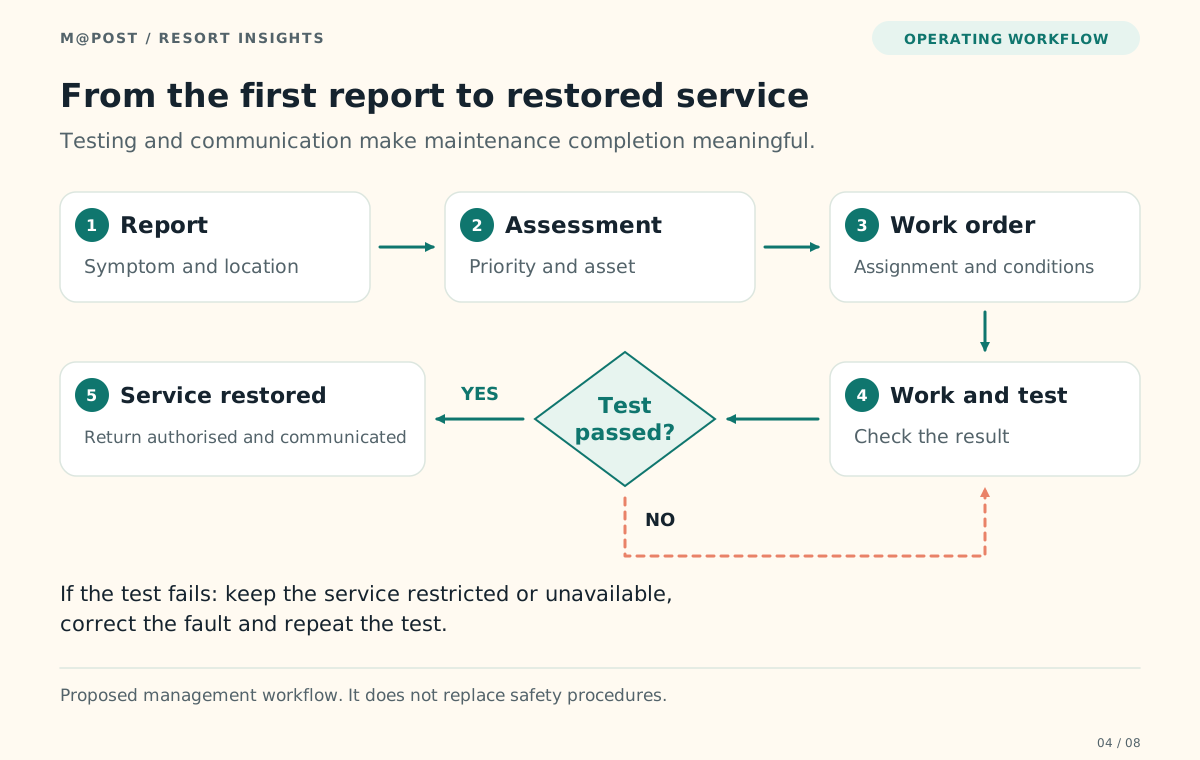
A report should describe the symptom, location, time of observation and perceived consequences. The person reporting it does not need to provide a diagnosis. The person accepting the job checks the priority, links the system and decides whether immediate restrictions, specialist skills or scheduled work are required.
The work order adds the operational information: the planned task, the assigned person, access conditions, materials, relevant documents and the evidence required at closure. Necessary precautions and authorisations must be established before work begins.
The decisive step is to distinguish work completed, test completed and service returned. A repair may be complete while the room is still not ready: it needs a test under the intended conditions, reinstatement of the work area and communication to reception. If a restriction remains, it must appear in the service status, with a responsible person and a review deadline.
The closure record should describe the defect found, the action taken, the components replaced and the verification result. “Fixed” leaves too much open to interpretation and prevents comparison with later incidents.
CMMS and building controls: connect information serving different purposes
A BMS, or building management system, monitors and controls the building's systems where one is installed. The CMMS organises people, tasks and maintenance history. The DOE guide describes the possibility of integrating control and maintenance management systems: integration is a capability to verify, not an automatic result of adopting a CMMS. [1]
A repeated alarm should not generate an unlimited series of identical work orders. Before introducing automation, establish which events create work, how duplicates are recognised, who assesses the signal and which test allows the incident to be closed. The connection should retain a reference between the alarm and the work order without transferring responsibility for the system's protective functions to the management software.
The information reception needs may be very simple: service available, restricted or unavailable; affected areas; and the time of the next expected update. Technical details remain accessible to those who need them.
Text description of this figure
Workflow from issue report to assessment and work order, followed by execution, testing and return to service; a failed test reopens the work order.
Start with a measurable scope
A limited initial scope allows the approach to be improved while the property continues operating. Choose a building or service, record its systems and follow all maintenance work for a defined period. The initial objective is to achieve complete records and traceable decisions, then expand the model.
Three measures help assess this first scope:
- Inventory coverage: systems recorded with all minimum fields complete, as a proportion of the systems actually included in scope.
- Documented closures: work orders completed with a recorded test result and an identified responsible person, as a proportion of closed work orders.
- Recurrence: problems returning on the same system with the same symptom within a defined period, to be examined without automatically assuming the same cause.
The denominators must remain clear. If the scope grows during the month, explain the comparison; a percentage may worsen because previously unknown systems have been identified, and that discovery is useful.
Preserve the information assets
Before entrusting day-to-day work to any platform, check data export, access management, retrieval of attachments and availability of historical records if the provider changes. The team should also be clear about how to operate during a connection outage.
In M@Post's Resort profile, the references to “Room / service area” and “Availability” — “Camera / area di servizio” and “Disponibilità” in the Italian interface — help connect an asset to its function within the property. The process can start with issue reports, work orders and preventive maintenance, checking the configuration in use. A consistent record, a clear assignment and verification of restored service form a practical foundation: they make each job useful to whoever works on the same system tomorrow.
Sources and references
- U.S. Department of Energy / Pacific Northwest National Laboratory — Operations & Maintenance Best Practices: A Guide to Achieving Operational Efficiency, Release 3.0 — chapter 4Published: 2010-08. Sources checked on 21 November 2026.Data period and scope: Technical guide, 2010 edition; not used as a performance benchmark.
How this source is used
General CMMS functions and possible integration with control or energy management systems.
Chapter 4, printed pages 4.1–4.3 (PDF pages 45–47). The commercial benefit percentages reported in the guide are not reproduced.
- European Centre for Disease Prevention and Control (ECDC) — Legionnaires’ disease — Annual Epidemiological Report for 2023Published: 2026-03-04. Sources checked on 21 November 2026.Data period and scope: 2023
How this source is used
1,501 travel-associated Legionnaires’ disease cases and 2,107 visits to accommodation establishments; an association with travel does not identify the source of infection.
Pages 8–9, sections TALD case reports and TALD case travel destinations. The 2024 report does not include the TALD surveillance summary; the data used here is explicitly from 2023. Other percentages and subtotals affected by textual inconsistencies in the document have been excluded.