Preventive maintenance in resorts: prepare for peak season before failures begin
Peak season concentrates demand and operational constraints. An effective preventive plan connects critical risks, work windows, spare parts and restoration tests, ending with a review of resort readiness.

In this guide
- Prepare for the season while there is still room to act
- What seasonality data shows — and its limits
- Choose what to prevent
- Build a sequence leading up to opening
- Verify the system under its expected operating conditions
- Prepare spare parts, access and people
- Check readiness as well as percentage complete
- Keep the plan active throughout the season
Prepare for the season while there is still room to act
Before opening for summer, a resort may have empty rooms, available contractors and accessible equipment. Once guests begin to arrive, the same tasks must fit around occupancy, food service, entertainment and guest requests. A technically straightforward job becomes difficult if it requires a shared service to be shut down.
Preventive maintenance uses that opportunity before it narrows. The programme must specify which forms of deterioration to monitor, which tasks to carry out and how to verify that the service is ready. The quality of the plan depends on the alignment between the planned work, the resources available and the consequences of potential failures.
A calendar full of low-value tasks can occupy the team while leaving the main risk unresolved. It is better to start with essential services and faults left over from the previous season.
What seasonality data shows — and its limits
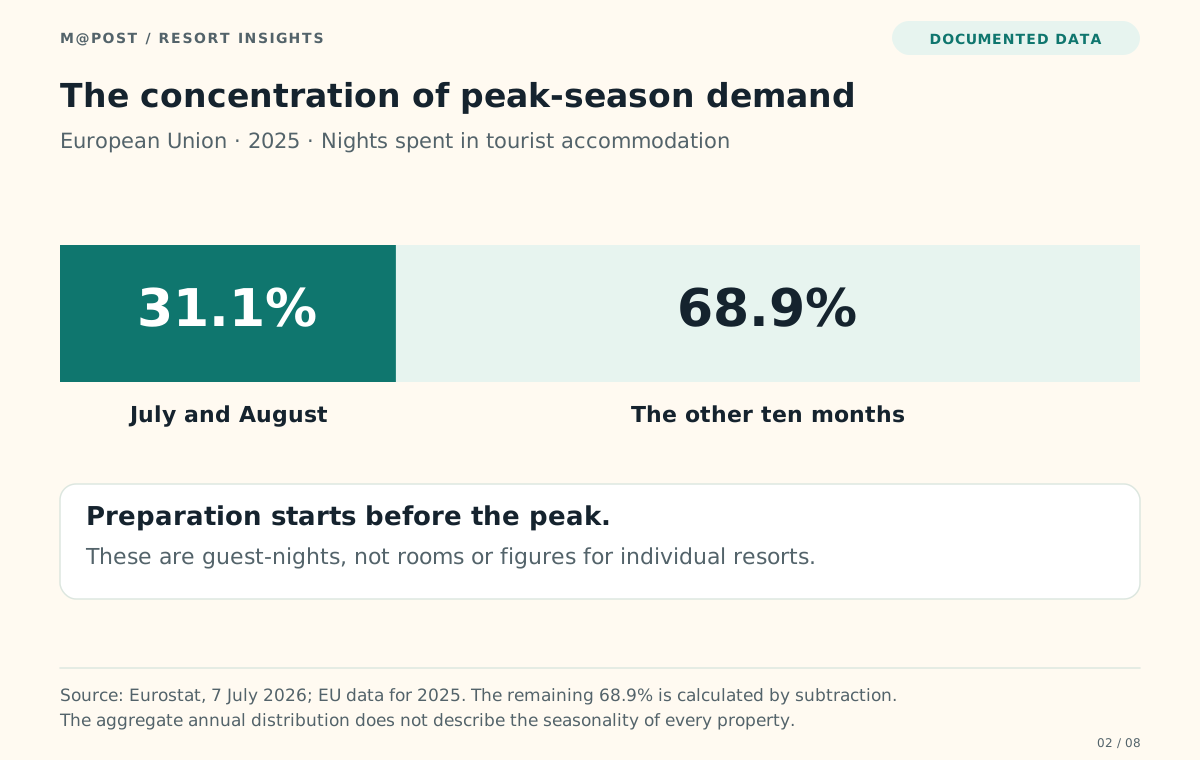
According to Eurostat, 31.1% of nights spent at tourist accommodation establishments in the European Union in 2025 fell in July and August. August recorded 3.6 times as many nights as January. The figures were published on 7 July 2026. [1]
These are guest-nights across tourist accommodation establishments, not occupied room-nights or equipment operating hours. The data describes the concentration of demand at European level; each resort must use bookings, its service calendar and local records to identify its own critical period. A mountain resort may have a second winter peak and require two separate seasonal readiness reviews.
The operational implication is to plan backwards from expected demand, allowing time to resolve the defects that checks uncover.
Text description of this figure
Bar showing total EU tourism nights in 2025: 31.1% in July and August and 68.9% in the other ten months.
Choose what to prevent
The Department of Energy guide distinguishes preventive maintenance, based on time or usage, from work driven by equipment condition. It also highlights the risk of unnecessary tasks or damage introduced by work that was not needed. [2]
A resort can use this distinction to build a selective programme. A replacement specified by the manufacturer serves a different purpose from checking for a leak or testing an alarm. Equipment with detectable deterioration may need periodic measurements; an inexpensive, easily replaced component with no significant failure consequences may justify a different strategy, with the reasoning documented.
For each priority system, it is useful to answer five questions: what function does it serve, how could it lose that function, what warning sign precedes the problem, which task is effective, and what happens if that task is not carried out? Frequencies and task content should be consistent with manuals, operating conditions, applicable requirements and recorded experience.
Build a sequence leading up to opening
The following schedule is an organisational proposal to adapt to the property. The intervals before opening are planning assumptions, not statutory deadlines.
| Indicative timing | Main decision | Evidence to obtain |
|---|---|---|
| Around 90 days before | Define major works and support arrangements | List of critical issues, quotations, contractor and spare-part availability |
| Around 60 days before | Carry out work that requires shutdowns | Work reports and remaining faults |
| Around 30 days before | Check operation and dependencies | Test results, measurements and owners for unresolved defects |
| Around 7 days before | Confirm operational readiness | Available services, stated limitations, on-call arrangements and stock |
| During the season | Monitor performance and recurring problems | Inspection rounds, issue reports and updated priorities |
The decisive step is to leave time between testing and opening. If the first complete check takes place the day before guests arrive, every problem it reveals becomes urgent because of the calendar.
Noisy, dusty or intrusive work also needs to be coordinated with cleaning, set-up and testing by other departments. The technical handover of a room should come before its final preparation for the guest.
Verify the system under its expected operating conditions
A system that starts at low load has not yet demonstrated that it can meet seasonal demand. The programme must include representative tests, defined by technicians in a way that is compatible with the system and with safety. These may cover distribution to distant outlets, equipment sequencing, the response of controls and recovery after a controlled fault condition.
For a pumping system with a standby pump, it matters which pump is actually available, how it is selected and how a failure is detected. Equipment that is out of service must be identified as such in operational documentation, handovers and the system's actual condition. A second unit provides useful standby capacity when that function has been verified.
Tests of safety systems, electrical installations and other specialist equipment require appropriate methods and competence. An editorial checklist can help organise evidence; technical procedures must be established for the particular installation.
Prepare spare parts, access and people
Spare-part availability affects recovery time. For critical components, staff need to know the correct part number, compatibility, storage location and procurement lead time. The decision to hold stock also depends on whether the part can be shared across equipment and whether it may expire or deteriorate in storage.
A package in the stores must be traceable to the equipment that uses it. Before the season, it is worth checking stock levels for selected spare parts, any specialist tools and access to plant rooms. Keep up-to-date contact details for external contractors and agree call-out arrangements.
Seasonal staff also need to be equipped to report problems effectively. The ENERGY STAR checklist for accommodation establishments includes observations on operation and leaks, complementing technical monitoring with the contribution of operational staff. [3]
A short on-site training session can show staff which signs to report, which channel to use and which situations require immediate communication. Every department should know who receives reports when the usual contact is absent.
Check readiness as well as percentage complete
The number of completed tasks is useful for managing workload, but readiness to open requires an assessment of the critical issues that remain. A plan may be almost complete while still containing one fault capable of compromising an essential service.
Illustrative example — assumptions, not observed data: of 100 planned tasks, 95 are complete. Progress is 95%. If the five open tasks include verification that the power supply for a critical service is available, that 95% says little about the service's readiness. The pre-opening meeting must also examine individual critical tasks and their associated operating conditions.
A concise overview can show, for each service, its availability, any restrictions, the test performed, open defects and the person responsible. Limitations must also be understood by staff who sell or allocate the service. Conditions incompatible with safety or applicable requirements must be resolved, or the affected service kept out of use, in accordance with the property's allocation of responsibilities.
Keep the plan active throughout the season
The season produces information that the initial plan did not contain. A filter may deteriorate faster than expected; a control setting may work at one load but become unstable at another; a problem may recur after a temporary repair. These observations warrant a review of the tasks, with the reasons for changes recorded.
During busy periods, a short meeting between maintenance and operational departments can help assess unavailability, intrusive works, arrivals and expected services. A CMMS supports continuity of the plan when every task has an identified asset or subject, a due date, an outcome and a connection to observed problems.
At the end of the season, the questions for management are which failures and service disruptions recurred, which checks detected them and which jobs should be included in the next shutdown. The preventive plan improves when the calendar incorporates what the property has actually learnt.
Sources and references
- Eurostat — Summer peak: 31% of tourism nights in August and JulyPublished: 2026-07-07. Sources checked on 21 November 2026.Data period and scope: 2025, nights spent at tourist accommodation establishments in the EU; dataset tour_occ_nim.
How this source is used
31.1% of annual EU tourism nights fell in July and August; August recorded 3.6 times as many nights as January.
Primary statistical source; guest-nights, not room-nights or a direct measure of equipment load. Includes accommodation types other than resorts.
- U.S. Department of Energy — Federal Energy Management Program / PNNL — Operations & Maintenance Best Practices: A Guide to Achieving Operational Efficiency, Release 3.0Published: 2010-08. Sources checked on 21 November 2026.Data period and scope: 2010 methodological guide, chapter 5; no savings percentage applied to resorts.
How this source is used
Distinction between time- or usage-based preventive maintenance and condition-based maintenance; limitations of unnecessary tasks.
Chapter 5, printed pages 5.3–5.4 (PDF pages 51–52). Only methodological concepts are cited; historical US regulatory references in the guide are not used.
- U.S. Environmental Protection Agency — ENERGY STAR — Energy and Water Efficiency Checklist for Hotels, Motels, and InnsPublished: 2024-06. Sources checked on 21 November 2026.Data period and scope: Technical checklist, edition under the June 2024 URL path.
How this source is used
The contribution of observations by operational staff to monitoring leaks and equipment operation.
US hotel checklist; cited as an operational tool without presenting it as an Italian requirement.