The true cost of an equipment failure in a resort: beyond the repair bill
The repair invoice describes only part of a failure. A method for distinguishing additional costs, lost revenue and contribution margin, compensation and reputational risks, with a checkable financial example.

In this guide
The invoice tells only part of the story
An equipment failure is often remembered through the spare part purchased and the technician's hours. Meanwhile, reception may have taken rooms out of service, moved guests, handled requests and offered compensation. The commercial team may have lost availability on the very dates when those rooms could have been sold.
Reconstructing the impact requires a shared event record: what happened, which services were affected, for how long and with what financial consequences. Maintenance, reception and finance each hold different parts of the information.
The aim is to make events comparable and support decisions on prevention, spare parts and investment. A credible figure comes from traceable line items, stated assumptions and the avoidance of double counting.
Four groups of financial effects
The first group covers additional costs of restoring service: spare parts, external services, urgent transport, equipment hire and overtime actually caused by the failure. Ordinary working hours of in-house staff should be recorded as a use of resources; their valuation must remain distinguishable from additional cash expenditure.
The second is the contribution margin lost on services not sold. An unavailable room causes a lost sale when demand exists that the resort cannot meet through equivalent alternative capacity. The effect on contribution margin also takes account of the variable costs actually avoided.
The third group covers the costs of managing inconvenience: compensation, substitute services, transfers and differences in the cost of alternative accommodation. Their accounting treatment needs to be checked, because a discount may already reduce recorded revenue.
The fourth covers further effects to assess: damage to assets, time diverted from other activities, disputes and reputation. Quantifying them requires specific evidence. Adding a flat percentage to every failure may create an appearance of precision while making comparisons unreliable.
Start with the room-nights actually lost
Taking ten rooms out of service for two nights creates twenty unavailable room-nights. To assess the financial loss, establish how many would have been sold and how many sales were recovered in other rooms or on other dates without an additional financial sacrifice.
Expected demand can be supported by bookings, requests turned away, sales trends and comparisons with appropriate periods. Where the data is uncertain, use explicit scenarios. Where bookings were already confirmed, the analysis begins with the actual outcomes: cancellation, relocation, a stay with compensation or another solution.
A shared financial vocabulary helps. In the STR/CoStar glossary, ADR is room revenue divided by rooms sold; RevPAR is room revenue divided by rooms available. They measure revenue, not profit. [1]
The room value used for an individual event should reflect the sales actually at risk. The annual average rate may be a poor representation of a shutdown on the busiest weekend. The scope of revenue must also be clear, especially for packages that include meals and other services.
A complete calculation with visible assumptions
Illustrative example — assumptions, not observed data. A failure takes 10 rooms out of service for 2 nights. Assume that 80% of those room-nights would have been sold, with no opportunity to recover the sales elsewhere in the resort. Expected revenue is €200 per room-night and the variable costs actually avoided are €40. Amounts exclude VAT; none of the figures represents a verified market rate.
| Item | Calculation | Amount |
|---|---|---|
| Unavailable room-nights | 10 × 2 | 20 |
| Expected lost room-nights | 20 × 80% | 16 |
| Lost room revenue | 16 × €200 | €3,200 |
| Avoided variable costs | 16 × €40 | €640 |
| Lost contribution margin | €3,200 − €640 | €2,560 |
| Additional repairs and spare parts | Assumption | €1,200 |
| Additional overtime | Assumption | €200 |
| Compensation to other guests who remained at the resort | Assumption | €300 |
| Estimated financial impact | €2,560 + €1,200 + €200 + €300 | €4,260 |
The compensation concerns other guests, separate from the sixteen room-nights that were not sold. This avoids charging the same consequence twice. The €3,200 of lost revenue is already reflected in the €2,560 contribution margin and must not be added to the total again.
The assumed additional cash outlay is €1,700; the contribution margin not earned is €2,560. The total describes these components of the event and does not claim to represent its entire effect on annual results. Fixed costs, accounting treatment and possible insurance recoveries require an approach agreed with finance.
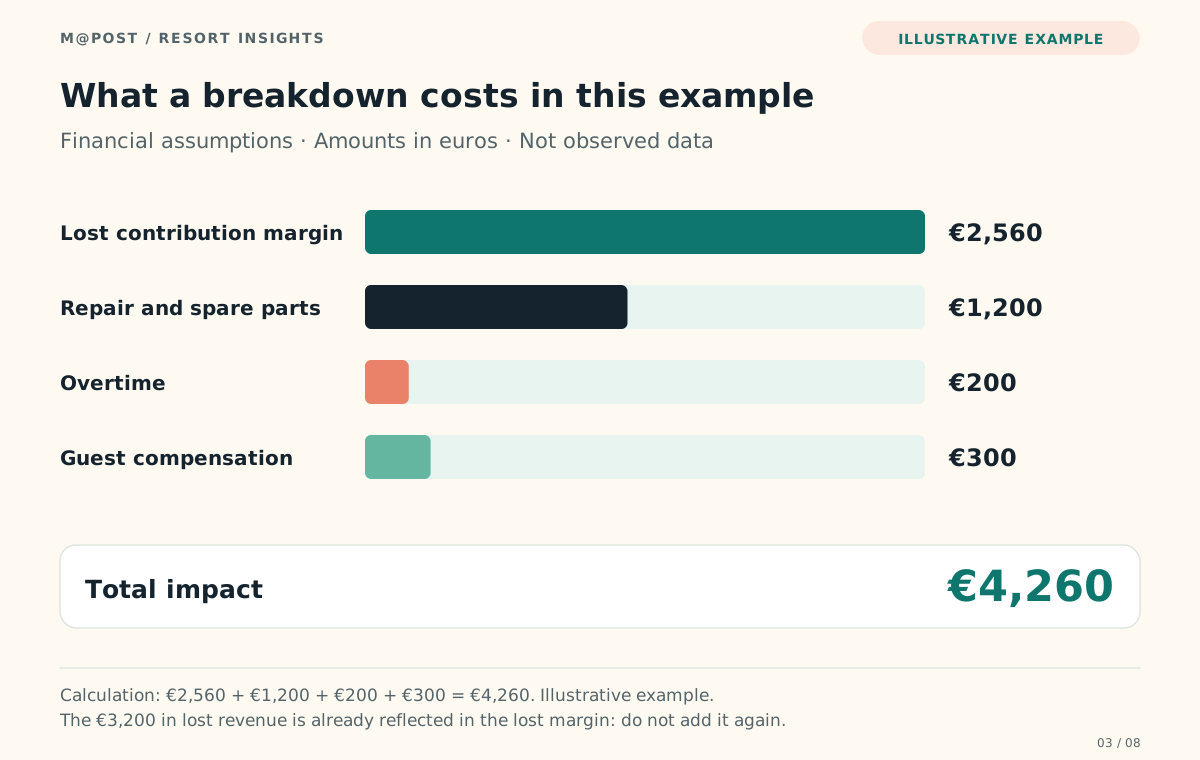
Text description of this figure
Four components of the example: €2,560 in lost contribution margin, €1,200 for repairs, €200 for overtime and €300 for compensation; total €4,260.
Reputation has value, but requires a disciplined approach
A study by Chris K. Anderson and Benjamin Lawrence, published in 2014 and available through Cornell University's repository, reports an association between a 1% increase in online reputation score and a 0.99% increase in RevPAR in the sample analysed, using ReviewPro and STR data. [2]
This is historical research on the relationship between reputation and hotel performance. It does not measure the effect of a single failure, does not demonstrate that a repair produces that change and is not a forecast for a resort in 2026. An assessment of the event therefore requires records of complaints and commercial recovery measures, keeping documented financial effects separate from those that remain uncertain.
Maintenance can contribute to the analysis by identifying recurring technical problems in reports. If several guests complain about the same symptom, it needs to be linked to a location, system and period. Reviews describe the experience; the technical investigation must establish the causes.
Keep sound records to avoid arbitrary estimates
Every significant event should have an identifier linking the work order, the service interruption and the commercial consequences. The period of unavailability should be recorded with its actual start and end, separating repair time from time spent waiting for spare parts, access, testing or handover.
For the financial assessment, retain a document or estimation method for each item: invoice, additional hours, affected booking, compensation and avoided cost. A field can identify whether an amount is an actual figure, an estimate or a scenario. When data becomes available, update the estimate and keep the reason for the change clear.
Commercial records contain personal information: the technical analysis needs only relevant identifiers and values, with access appropriate to each role. Maintenance staff need to understand the impact of the shutdown and the priority of restoring service, while guest details remain within the processes that manage them.
Use the event cost to make decisions
Reconstructing the financial impact helps compare alternatives. A stocked spare part may reduce waiting time; a modification may eliminate a recurring cause; a check may detect deterioration early; different access to a plant room may shorten the job. Each proposal should estimate which part of the problem it can actually improve.
The cost of a past event does not automatically become a future saving. An investment should be assessed against a plausible frequency of occurrence, the probability that the measure will be effective, running costs and the period of use. If data is limited, reasoned scenarios make the decision more transparent than a single apparently certain financial return.
To begin, the resort can select a few recent events with visible consequences and reconstruct them with reception and finance. The CMMS can hold the technical references; commercial and accounting information completes the picture through defined links and responsibilities.
The useful outcome for management is a reasoned choice: which action reduces a significant consequence, which assumptions support the forecast and how the result will be verified. Maintenance then gains a financial measure that is understandable and connected to the services the resort must keep available.
Sources and references
- CoStar — STR Benchmark — Glossary: Average Daily Rate (ADR) and Revenue Per Available Room (RevPAR)Sources checked on 21 November 2026.Data period and scope: Glossary accessed on 21 November 2026; definitions, not a market estimate.
How this source is used
ADR = room revenue / rooms sold; RevPAR = room revenue / rooms available.
Entries for Average Daily Rate and Revenue Per Available Room. The former STR website redirects to CoStar; the final URL actually consulted is used.
- Cornell University eCommons / Service Science (INFORMS) — Anderson, C. K.; Lawrence, B. — The Influence of Online Reputation and Product Heterogeneity on Service Firm Financial PerformancePublished: 2014-11-01. Sources checked on 21 November 2026.Data period and scope: Historical study published in 2014; not current market data. The sample period is not specified in the abstract consulted.
How this source is used
Association within the sample between a 1% increase in online reputation score and a 0.99% increase in RevPAR.
Finding verified in the institutional repository abstract; DOI 10.1287/serv.2014.0080. Not interpreted as causation or as a maintenance multiplier. PDF not obtained: the download returned HTTP 429; metadata and abstract were available.