The maintenance guests never see: why reliable building services determine the quality of a resort
Guests judge the comfort of their room and the continuity of services. Behind those experiences are systems, people and checks: here is how maintenance becomes quality that guests can feel and managers can measure.
In this guide
- Service begins behind the scenes
- What guest satisfaction data tells us
- Connect every promise to a technical system
- Prioritise the consequences
- Turn staff into a network of observers
- Close the work order when service has been restored
- Measure the technical side of the guest experience with a few indicators
- A first application over thirty days
Service begins behind the scenes
A family arrives in its room after a journey. They expect a comfortable temperature, hot water, working lights and a quiet environment. That evening, they want the restaurant to be open; the next day, they want to use the pool. Each expectation depends on a chain of systems and activities: heating and cooling generation and distribution, water treatment, electrical supply, refrigeration, checks and maintenance work.
Guests experience the final result of that chain. For management, the quality of maintenance is therefore a tangible part of the service being sold. A room may look immaculate yet be unusable because of an air-conditioning problem. A system may appear to be running on its control panel while delivering inadequate performance at its most distant outlet.
The starting question is simple: what technical conditions must be in place for every promised service to be genuinely available?
What guest satisfaction data tells us
The J.D. Power North America Hotel Guest Satisfaction Index 2025, based on 39,219 guests at branded hotels whose stays took place between May 2024 and May 2025, reports that 12% experienced a problem during their stay. Reported satisfaction was 460 points out of 1,000 among guests who encountered problems, compared with 677 among those who did not. The issues covered include noise, odours, cleanliness and check-in problems. [1]
The study covers North America and problems of several kinds: the 12% figure is not an equipment failure rate, nor an estimate for Italian resorts. It provides a reason to examine the guest experience alongside operational problems. Establishing the contribution of maintenance within a particular resort requires local classifications and records.
Connect every promise to a technical system
An inventory organised solely around equipment leaves management to translate assets into services. It is more useful to complement it with a service map: what the guest receives, which systems make it possible, which signs warn of deterioration and what alternative is available while service is being restored.
| Service experienced by the guest | Systems to connect | Signs to record |
|---|---|---|
| A comfortable room | Air conditioning, controls, ventilation, shading | Failure to reach the required temperature, noise, condensation, repeated complaints |
| A usable shower | Water heating, storage and distribution | Waiting times, fluctuations, insufficient pressure, leaks |
| An available pool | Circulation, filtration, treatment, power supplies | Alarms, abnormal monitored parameters, shutdowns and restrictions |
| Continuous food service | Refrigeration, cooking, washing, extraction | Shutdowns, inadequate performance, temporary repairs |
| Accessible, well-lit spaces | Access routes, lighting, doors, lifts | Closed-off areas, inadequate lighting, unavailability |
The table is an organisational framework. The actual safety, hygiene and technical checks must be defined for each system by the competent people responsible, using the relevant documentation and applicable requirements.
This map also helps identify shared dependencies. Two machines may depend on the same electrical panel or circuit: their number alone says little about continuity of service.
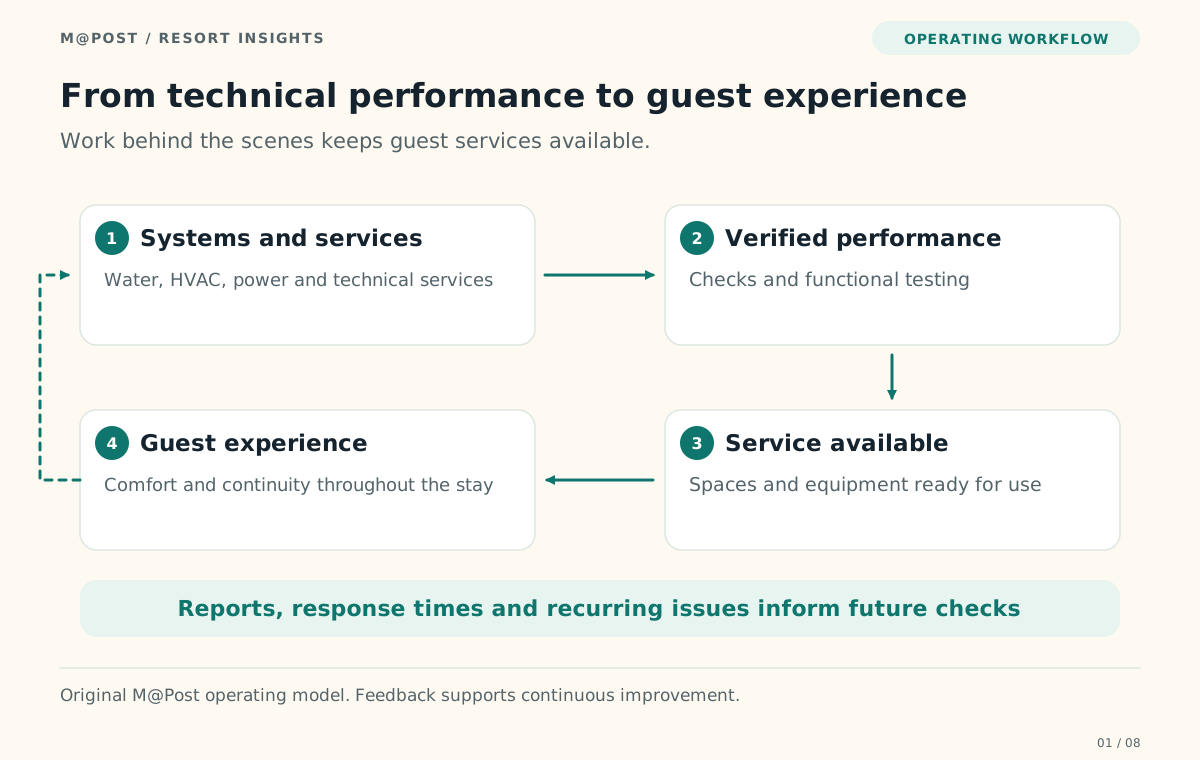
Text description of this figure
Four stages connect systems, verified performance, available service and the guest experience; issue reports feed back into planning.
Prioritise the consequences
Assigning a priority requires consideration of at least four factors: the safety consequences, the number of users or services affected, the availability of an alternative and the time needed to recover. Engineering management may also include environmental exposure and the risk of damage to other assets.
A failed lamp in an adequately lit room calls for a different response from a fault on an essential access route. A contained leak in an accessible location requires different management from a hidden leak above occupied rooms. The priority follows from the actual consequence and the conditions at the time.
A resort can adopt a few categories that everyone understands: immediate action for critical conditions, urgent action when an essential service is impaired, and scheduled work for defects compatible with continued operation. Each category needs a designated owner, an escalation process and a final verification criterion. Response times should reflect the resort's actual organisation.
Turn staff into a network of observers
Housekeeping, reception and maintenance see different parts of the same problem. Housekeeping notices a stain or a drip; reception hears about the inconvenience; maintenance identifies the technical cause. A shared vocabulary makes it possible to connect these observations.
The ENERGY STAR checklist for hotels, motels and inns encourages involving housekeeping staff in reporting leaks and using lights and controls thoughtfully. This is a practical example of how day-to-day monitoring can begin during routine service activities. [2]
A useful report includes the precise location, the observed symptom, the time, the operating conditions and the effect on service. “Room 214: the noise starts when the fan speeds up” supports a more focused diagnosis than “noisy air conditioner”. A photograph can complete the description, avoiding images of guests or their personal belongings.
Staff who report a problem should be able to see that their request has been acknowledged and learn the outcome relevant to their work. This feedback helps improve subsequent reports.
Close the work order when service has been restored
Replacing a component is one stage of restoring service. Before a room can be handed back, performance must be checked under the intended operating conditions, the work area put in order and availability communicated to the department responsible for it.
For an air-conditioning terminal unit, verification may include reaching the required condition, checking the behaviour of the controls and confirming that the symptom which prompted the report is absent. The specific tests must remain appropriate to the equipment and the work carried out.
It is useful to record three separate times: receipt of the report, restoration of service and administrative closure of the work order. The time experienced by the guest runs until service is actually restored. If a repair ends at 14:00 but reception does not learn until 17:00 that the room is available, the information handover has also caused unavailability.
A temporary solution should have a deadline and a named person responsible for the permanent resolution. This keeps it visible after the immediate inconvenience has ended.
Measure the technical side of the guest experience with a few indicators
To begin with, a resort can adopt three internal measures: room-nights taken out of service for technical reasons, technical issue reports per 100 occupied room-nights, and the proportion of problems that recur within a period defined by the resort. For the last indicator, the same equipment and the same symptom must be identified, to avoid grouping different failures together.
Out-of-service room-nights measure unavailable capacity; reports describe problems that have been detected. An initial rise in reporting may result from better data collection. To interpret it, examine severity, recurrence and duration alongside occupancy volumes.
Illustrative example — assumptions, not observed data: 24 technical issue reports in a month with 2,400 occupied room-nights equal 1 report per 100 occupied room-nights. This figure becomes meaningful when compared with equivalent periods at the same resort and with the mix of problems involved. The threshold for attention comes from the chosen service objective, not from the example itself.
A first application over thirty days
A practical starting point is one block of rooms and the systems serving it. In the first week, map the systems and responsibilities. In the second, standardise issue reporting. In the third, review how restoration of service is confirmed. In the fourth, management, reception and maintenance review recurring problems and time lost during handovers together.
The expected result is a short list of decisions: eliminate a recurring cause, bring a check forward, improve a handover or make a spare part available. A CMMS can support this approach when asset records, responsibilities and work records are maintained consistently.
For M@Post, discussing resort maintenance begins with this connection: verified technical performance makes a service available, and that service becomes part of the guest experience. The work completed can then be assessed against the resort's actual operating conditions.
Sources and references
- J.D. Power — 2025 North America Hotel Guest Satisfaction Index (NAGSI) StudyPublished: 2025-07-15. Sources checked on 21 November 2026.Data period and scope: Stays between May 2024 and May 2025; 39,219 guests at branded hotels in North America.
How this source is used
12% of guests experienced a problem; satisfaction was 460/1,000 among guests with problems, compared with 677/1,000 among those without problems.
Primary source for the study. The problems cover several categories: they must not be equated with equipment failures, a rate for Italy or a causal effect of maintenance. The page also shows a site update dated 3 August 2026; the press release in the body is dated 15 July 2025. Editorial use with attribution, without reproducing charts or logos or implying endorsement.
- U.S. Environmental Protection Agency — ENERGY STAR — Energy and Water Efficiency Checklist for Hotels, Motels, and InnsPublished: 2024-06. Sources checked on 21 November 2026.Data period and scope: Technical checklist, edition published under the June 2024 URL path; not a statistical study.
How this source is used
Involving housekeeping in reporting leaks and managing lighting and controls.
Page 1 of the checklist; a US operational recommendation, not an Italian regulatory requirement.