Maintenance contractors: how to stay in control of a resort
A maintenance contract works when it specifies the assets covered, responsibilities, timescales and acceptance criteria. A method for coordinating resort contractors and measuring the service delivered.

In this guide
The contractor's technician arrives, carries out the work and signs the report. The invoice is correct, but the fault returns and reception is still dealing with complaints. When this happens, the useful question is very specific: what result was required, how was it to be verified, and who was authorised to accept it?
A resort relies on specialists for heating and cooling, lifts, kitchens, electrical systems, water treatment and other services. Their contribution is essential. Coordinating it, however, requires internal oversight that can connect the different activities, manage risks arising from their interaction and recognise when a system can be returned to service.
The contract starts with its scope
The phrase “maintenance of the systems” can create very different expectations. Before comparing quotations, establish which assets are included, where they are located, what activities are required and which conditions call for an unscheduled intervention.
The asset list should identify equipment clearly and be easy to update. When a machine is replaced, the contract must be able to accommodate the new asset and its requirements. It is useful to distinguish activities included in the regular fee from spare parts, consumables, additional call-outs, on-call cover and work requiring a quotation.
Exclusions also need an owner. If maintenance of a pump is included but its power supply panel falls under another contract, someone must coordinate diagnosis across that boundary. Leaving technicians to negotiate this interface during an outage transfers the cost of ambiguity to the service.
A record for each contract is useful for the resort: assets covered, internal contact, contractor's contact, validity period, activities, critical spare parts, permitted call-outs and acceptance criteria.
Safety needs coordination before work begins
A historical reference helps explain why maintenance deserves specific attention. EU-OSHA Facts 90, prepared for the 2010–2011 campaign, reports that data from several European countries for 2006 associated around 10–15% of fatal accidents with maintenance activities. This is historical evidence covering multiple sectors: it does not measure contracting in resorts or describe the sector's current situation. [1]
In everyday work, prevention takes the form of concrete decisions: making the area accessible under suitable conditions, making equipment safe, assessing risks from interacting activities, informing people and agreeing restart conditions. Working in a kitchen during meal preparation presents different problems from working on the same equipment on a day when the kitchen is closed.
In Italy, within the applicable scope of Article 26 of Italian Legislative Decree 81/2008, the requirements include checking technical and professional suitability, providing information about workplace risks, and cooperation and coordination. The rules concerning the Italian document assessing risks from interference between activities, known as the DUVRI, and any applicable construction-site rules must be assessed against the actual work. Maintenance interventions should not all be treated as equivalent. [2]
INAIL's 2019 publication on maintenance safety discusses the management of contractors and suppliers, from selection through to supervision of the work. Its organisational message is also relevant to hospitality: the documents collected before an appointment must be reflected in the actual working conditions. [3]
Check competence for the work required
Qualification must be relevant to the systems and activities assigned. Alongside applicable requirements, the client can assess experience with the installed technologies, staff availability, the instruments needed for testing, the ability to obtain spare parts and continuity of service during peak periods.
A general reference does not answer a specific question: who will work on that component, and what diagnostic capability will they have? The answer should be established before an emergency. Any subcontracting needs to be managed so that the companies and people working on site remain identifiable.
To prevent information from becoming scattered, the contractor's file can hold verified requirements, relevant expiry dates and the scope of authorised activities. Whether a document is valid and whether a contractor is suitable for a particular task remain separate assessments.
Write SLAs around measurable events
A service level agreement, or SLA, must state which event starts the clock and which event determines whether the requirement has been met. “Intervention within four hours” is ambiguous if one person means a telephone call and another means restoring hot water.
| Stage | What to record | What makes the result verifiable |
|---|---|---|
| Fault report | Time, channel, symptom, asset and priority | Request received through the agreed channel |
| Job acceptance | Contact accepting responsibility and time of acceptance | Operational responsibility assigned |
| Arrival or technical connection | On-site attendance or actual remote assistance | Start of the activity specified in the contract |
| Making safe | Measures taken, responsible person and time | Defined conditions to protect people and equipment |
| Service restoration | Test outcome and time of handover | Service meets the agreed conditions |
These stages do not impose a rigid sequence. Competent staff already on site may need to make the situation safe immediately, without waiting for the contractor. Emergency response follows the property's procedures.
The contract must also clarify coverage hours, public holidays, priority classes, escalation and the treatment of waiting time. If access or authorisation is unavailable, the reason and responsibility should be recorded. Even when the contract permits a pause in its response clock, the guest continues to experience the service outage.
An example of interpreting times
Illustrative example — assumptions, not observed data. The service outage begins at 09:00 and is reported immediately; the request is accepted at 09:10 and the technician arrives on site at 10:20. Service becomes available again at 13:00 after the specified test. The time to accept the job is 10 minutes, the time from opening the request to arrival is 80 minutes, and the outage in this example lasts four hours.
If the contract required arrival within 90 minutes, that requirement would have been met. We could not, however, conclude that service had been restored within 90 minutes. Recording both times enables management to understand whether faster attendance, available spare parts or an operational alternative is needed.
Accept the work using an agreed test
The job report should connect the symptom, diagnosis, work performed, materials and result. For significant activities, the measurements, tests or evidence required for acceptance need to be established in advance. Their content depends on the work: a functional test, a documented measurement and a specialist report are not interchangeable.
The person overseeing the resort must know whether the system is available, whether it is operating with restrictions and whether a temporary measure still needs replacing. Repairing a component does not automatically resolve a system-level anomaly: it may be necessary to verify behaviour under actual service demand.
Work that changes configurations or connections requires the affected documents to be updated. If the solution is temporary, it needs an owner and a review date, so that a temporary measure does not disappear into the maintenance history as a permanent repair.
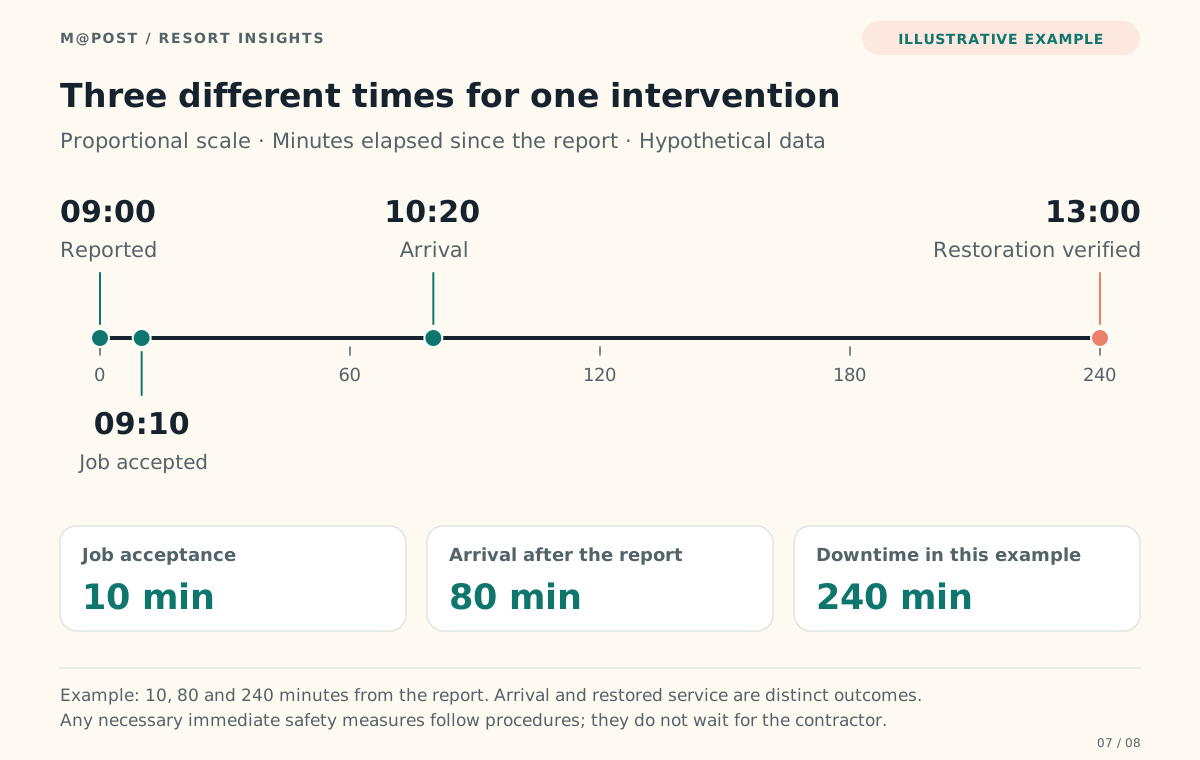
Text description of this figure
Timeline for a hypothetical example: fault reported at 09:00, job accepted at 09:10, arrival at 10:20 and service restored at 13:00. Times: 10, 80 and 240 minutes.
Assess contractors with a few consistent measures
Periodic review can focus on compliance with commitments, the quality of service restoration and the completeness of supporting evidence. For each contractor, useful measures include:
- the proportion of eligible requests answered within the contractual time, with the number of cases and any exclusions;
- jobs requiring a return visit for the same problem within a defined period, after verification of the cause;
- complete reports delivered within the agreed timescales;
- overdue work or corrective actions, separated by criticality and responsibility.
The figures must be read alongside the scope of the work. A contractor called only for complex failures cannot be compared directly with one performing simple, scheduled inspections. It must also be possible to report anomalies found during the work without the report itself becoming grounds for a penalty.
A CMMS can make contracts, assets, requests and evidence accessible. When applying this method with M@Post, check the functions available and continue to assign decisions to competent people. The intended result is a working relationship that can be verified: every specialist knows their remit, and the resort retains a complete view of the service.
Sources and references
- European Agency for Safety and Health at Work (EU-OSHA) — Facts 90 — Maintenance and OSH: A statistical picturePublished: 2010. Sources checked on 21 November 2026.Data period and scope: 2006 for the fatal accident figure; historical source
How this source is used
In several European countries, around 10–15% of fatal accidents in 2006 were associated with maintenance activities.
Page 2 of the PDF, text beside Figure 2. Multisector data; not presented as current incidence or as specific to contracting or resorts.
- Italian Republic — Normattiva — D.Lgs. 9 aprile 2008, n. 81, articolo 26 — obblighi connessi ai contratti d’appalto o d’opera o di somministrazionePublished: 2008-04-30 and subsequent amendments. Sources checked on 21 November 2026.Data period and scope: Current text accessed on 21 November 2026; reference to the principles in paragraphs 1–3
How this source is used
Technical and professional suitability, risk information and cooperation/coordination within the applicable scope of Article 26 of Italian legislation; DUVRI requirements to be assessed for the specific case.
Cross-checked against the text of Article 26 in the official Department of Finance database and INL publications. The citation refers to the consolidated Normattiva text, not an exhaustive checklist of requirements. The original Italian legal title is retained to identify the source.
- INAIL — La manutenzione per la sicurezza sul lavoro e la sicurezza nella manutenzionePublished: 2019-05. Sources checked on 21 November 2026.Data period and scope: 2019 technical guide; organisational guidance, not independent verification of current legislation
How this source is used
Management and supervision of contractors/suppliers, qualification and verification of the work performed.
Chapter 12, particularly pp. 139–143. The contract content and indicators proposed in the article are editorial operational guidance, not reproductions of the INAIL tables. The original Italian publication title is retained to identify the source.