Maintenance and sustainability in resorts: less waste, measurable results
Repairing a leak, correcting a setting, choosing the right replacement part: how to turn resort maintenance into verifiable environmental and financial results.

In this guide
- Sustainability is visible in the plant room too
- A real case: less water after a sanitary fixture retrofit
- Define the boundary before calculating an indicator
- Four areas in which to look for useful interventions
- Use benchmarks to prompt questions, not award marks
- Put a value on small leaks
- Check that the benefit lasts
- The resort's first step
Sustainability is visible in the plant room too
A tap is still dripping after housekeeping has been through. A pump runs under the same conditions throughout the day, even as demand changes. An air-conditioning system heats and cools neighbouring spaces without effective coordination. These are situations in which a resort's environmental commitments meet the practical work of maintenance.
The useful question is specific: what waste have we eliminated, what evidence supports that conclusion, and what level of service have we maintained? Answering it means linking the fault to the asset, the intervention and the subsequent measurement. A lower utility bill alone does not show that maintenance has improved efficiency: energy prices, occupancy, weather or the services in operation may have changed.
A real case: less water after a sanitary fixture retrofit
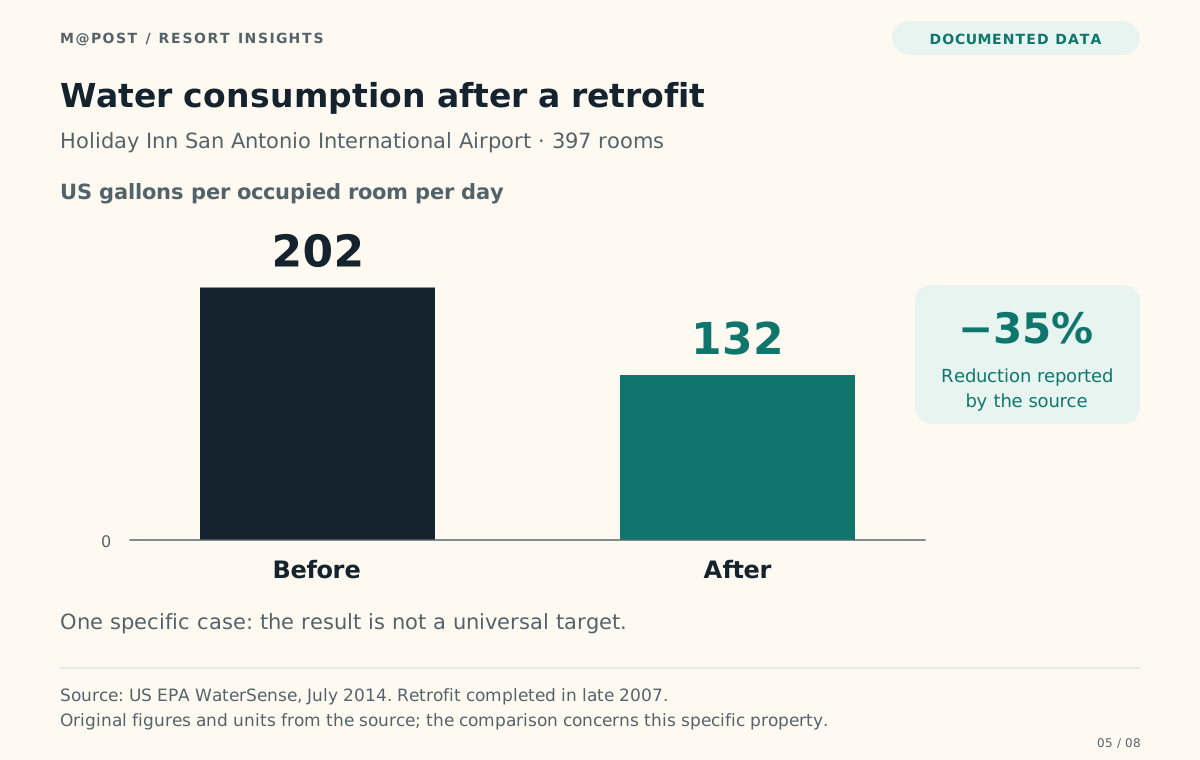
The US Environmental Protection Agency documents the case of the Holiday Inn San Antonio International Airport, a hotel with 397 rooms. Following a sanitary fixture retrofit completed at the end of 2007, consumption fell from around 202 to 132 US gallons per occupied room per day, a reported reduction of 35%. The case study was published in July 2014. It concerns a particular property and intervention, with older fixtures in place beforehand: the percentage cannot automatically be transferred to an Italian resort.[1]
The operational lesson is that a technical decision can affect consumption without relying entirely on guests' behaviour. Applying that lesson requires a description of the starting conditions, an appropriate intervention and measurement of its effects. If the resort already has efficient taps and fittings, the same retrofit might deliver a much smaller benefit. Repairing leaks, correcting a control setting or reviewing operating hours might be a higher priority instead.
Text description of this figure
Two bars show 202 US gallons per occupied room per day before the retrofit and 132 afterwards.
Define the boundary before calculating an indicator
A measurement changes meaning when the services included in it change. Water consumption at a hotel with a restaurant, swimming pool, in-house laundry and extensive gardens is not directly comparable with that of a property that outsources these services. The Hotel Water Measurement Initiative, developed for the hotel sector, provides measures per occupied room and considers the scope of activities, including certain outsourced operations.[2]
For day-to-day management, it is useful to retain two levels of measurement. The main meter describes overall demand; submeters help attribute changes to the kitchen, laundry, irrigation, pools and other uses. If a departmental measurement is unavailable, any estimate should be identified and kept separate from measured data. This prevents an apparently precise result from concealing an arbitrary allocation.
The denominator also needs attention: an occupied room and an overnight guest are different units. Two people staying in one room generate one occupied room-night and two guest-nights. Switching between these two bases can suggest an improvement or deterioration that is simply a consequence of how the figures are counted.
Four areas in which to look for useful interventions
| Area | Signal to investigate | Maintenance action to consider | Evidence of the result |
|---|---|---|---|
| Water networks and outlets | Persistent flow during periods of low demand | Locate leaks and restore watertightness | Consumption profile before and after the intervention |
| Hot water production and distribution | Unusual waiting times, heat losses or irregular recirculation | Check operation, insulation and system balancing | Technical measurements and service quality |
| Heating and cooling | Consumption or operation inconsistent with usage and outdoor conditions | Check sensors, filters, heat exchangers and control sequences | Comparable consumption figures and comfort parameters |
| Pools, laundry and irrigation | Unusual top-up volumes, cycles or discharges | Check components and programmes against the service required | Measured volumes and process checks |
This table is a suggested working framework, to be adapted to the systems installed. Changes must maintain the required performance and safety conditions. Reducing a flow rate, temperature or treatment time without considering its purpose may simply shift the problem from consumption to service quality.
A useful intervention also leaves a record of the conditions under which service was restored: approved settings, components replaced, the test performed and the person responsible for verification. Without this record, a setting may be changed again following the first complaint, and the saving may disappear without anyone identifying why.
Use benchmarks to prompt questions, not award marks
Research by the European Commission's Joint Research Centre identifies a benchmark of excellence for full-service hotels of 140 litres per guest-night or less. This reference draws on good practice and the performance of leading properties. It does not represent average market consumption, a general legal requirement or a threshold automatically suited to every resort.[3]
Before adopting it as a target, check whether the scope is comparable: the activities included, occupancy, climate and any particular services. A resort can use it to initiate an analysis, but should set its own targets on the basis of a reliable water balance. The improvement plan should explain where water savings are expected and who is responsible for delivering them.
Put a value on small leaks
Illustrative example — assumptions, not observed data. A continuous leak of 0.5 litres per minute amounts to 720 litres per day. Over 30 days, that is 21.6 cubic metres. Assuming a total variable charge of €3 per cubic metre, the avoidable cost is €64.80 per month. This calculation covers only water and the associated services included in the assumed tariff.
If hot water is leaking, there may also be an energy cost, which should be calculated using the actual temperature, volume, efficiency and price. Adding a generic energy figure would make the calculation less credible. Similarly, an intermittent leak requires its actual duration of flow: a rate observed for a few minutes cannot be applied to an entire month.
This method helps prioritise reports. A small but continuous leak may warrant prompt attention, while a high, steady level of consumption may be necessary to deliver the service. The indicator identifies a pattern; a site inspection and analysis establish what it means.
Check that the benefit lasts
For each improvement, it is useful to create a record of the initial problem, the available measurement, the expected result, cost, responsible person and review date. Verification should follow a representative period and be repeated when the season or operating pattern changes.
The comparison should report absolute consumption alongside intensity indicators. If guest-nights increase, total consumption may rise even as efficiency improves. If part of the property closes, the total may fall without any technical improvement. Recording these changes enables management to interpret the results correctly.
A similar principle applies to materials: record what is replaced, why, and the outcome. Extending a component's useful life makes sense when reliability and performance remain adequate. Deferring a necessary replacement is not a demonstrated environmental benefit, particularly if it increases failures, consumption or repeat repairs.
The resort's first step
Start with a single service that consumes substantial resources and a sufficiently reliable measurement. The engineering manager identifies anomalies; management sets a priority; and the intervention is verified using the same criteria used to describe the problem. The method can then be extended to other departments.
A CMMS can support this process by linking assets, interventions and evidence, according to the functions actually available and configured. The useful information to bring into M@Post is this connection: what was done, what result was measured and whether that result was sustained. It provides a concrete basis for discussing sustainability with the people who run the resort and those who use its services.
Sources and references
- US Environmental Protection Agency — WaterSense — Putting WaterSense to Work: Hotel Installs Water-Efficient Sanitary FixturesPublished: 2014-07. Sources checked on 21 November 2026.Data period and scope: Retrofit completed at the end of 2007; the case study describes a comparison before and after the intervention
How this source is used
397 rooms; consumption of 202→132 US gallons per occupied room per day; reported reduction of 35%.
Two-page PDF, with a summary on page 2. The energy savings stated in the document are estimated, not measured, and are not used as observed data in this article.
- World Sustainable Hospitality Alliance — Hotel Water Measurement Initiative (HWMI)Sources checked on 21 November 2026.Data period and scope: Methodology page accessed on 21 November 2026; linked methodology version 1.1
How this source is used
Metrics per occupied room; boundaries include hotel activities and, where applicable, outsourced operations.
The About HWMI and What’s included in the calculation sections; the current number of participants is not used.
- European Commission — Joint Research Centre — Water management in the European hospitality sector: Best practice, performance benchmarks and improvement potentialPublished: 2016-07-01 (JRC record date); DOI with a 2014 publication identifier. Sources checked on 21 November 2026.Data period and scope: Study of good practice and benchmarks, not annual statistics for 2026
How this source is used
Benchmark of excellence of ≤140 litres per guest-night for full-service hotels.
The abstract explicitly identifies a benchmark for leading properties. It is neither an average nor a general legal requirement.